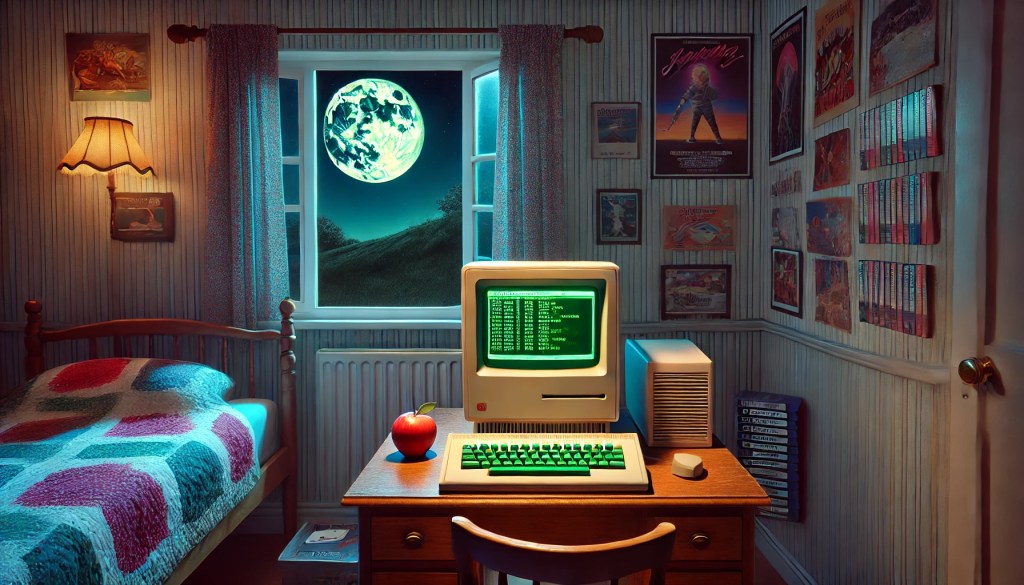
The 1980s home PC was more than a technological marvel—it was a lifestyle. These early computers didn’t just sit on desks; they transformed rooms into command centers of innovation, entertainment, and discovery. For many, they became a gateway to sleepless nights filled with endless possibilities, their hum and glow creating an intimate connection with a world just beginning to embrace the digital age.
A typical 1980s home PC setup was both a status symbol and a family treasure. Machines like the Commodore 64, the Apple II, or the IBM PC dominated desks, often nestled amidst stacks of floppy disks, thick manuals, and CRT monitors that cast a soft, flickering light across the room. Nearby, dot-matrix printers waited to spring to life with their unmistakable screeches, churning out perforated pages of triumphs and creations.
These computers weren’t just tools—they were magical devices that brought the future into the present. Owning one meant holding a piece of tomorrow in your hands, an invitation to explore uncharted territories. Every keypress felt like unlocking a new possibility, and every boot-up was a small celebration of human ingenuity.
Endless Nights of Discovery

As the day wound down and the house fell quiet, the home PC came alive. There was something almost sacred about these late-night sessions. The room darkened except for the computer screen’s gentle glow, illuminating your face as you leaned in closer, utterly absorbed. The click of keys, the soft hum of the CPU, and the occasional whir of a disk drive created a symphony of productivity and wonder. Time seemed to evaporate as you lost yourself in the possibilities that lay before you.
Gaming was one of the most alluring aspects of the 1980s PC experience. These weren’t just distractions; they were full-fledged adventures. Text-based games like Zork plunged players into intricate, imaginative worlds where every decision shaped the narrative. Early graphic titles like King’s Quest offered stunning pixelated landscapes, pushing the boundaries of what technology could achieve. And flight simulators like Microsoft Flight Simulator transported users to the skies, proving that even the mundane could be extraordinary.
Beyond gaming, late-night sessions often became a playground for creativity. Budding programmers experimented with BASIC, spending hours typing out lines of code to create simple yet deeply satisfying programs. The thrill of watching a self-written script come to life on the screen was unparalleled. Artists painstakingly designed pixel art, and writers drafted stories with newfound ease on word processors. Each creation felt deeply personal, a testament to the user’s imagination and persistence.

For many, these nights weren’t just about productivity—they were about possibility. The quiet hours, when the world outside seemed to pause, left you alone with your thoughts and the machine. Every challenge overcome, whether a stubborn bug in a program or a particularly tricky puzzle in a game, felt like a triumph.
The Joy of Creating
The home PC wasn’t just about playing games; it was about making things. The 1980s saw a surge of interest in programming, with BASIC serving as the entry point for many budding coders. Hours were spent typing out lines of code from magazines or experimenting with personal projects. The joy of seeing a program run successfully—a bouncing ball, a custom calculator, or a simple text-based game—was a triumph of human and machine working together.
For those with an artistic bent, early graphics programs offered a new kind of canvas. Creating art, one pixel at a time, was a labor of love, with each finished piece a testament to patience and creativity. Musicians dabbled with rudimentary music composition tools, and writers abandoned their typewriters for the sleek efficiency of word processors, marveling at the ability to edit without leaving behind messy correction fluid or eraser shavings.
The tactile nature of these tasks added to the experience. Loading a program meant inserting a floppy disk and waiting as the drive whirred to life. Saving work involved careful labeling and organizing disks to avoid losing precious creations. These physical interactions were a reminder of the tangible connection between user and machine, a bond that feels almost lost in today’s era of instant downloads and cloud storage.
The Heart of the Household
For many families, the home PC became a shared treasure. Parents marveled at its ability to help with finances, creating budgets and spreadsheets with programs like Lotus 1-2-3. Children used it for schoolwork, crafting reports that looked far more professional than anything handwritten. And everyone gathered around for multiplayer games, taking turns and cheering each other on in a display of communal excitement.

These machines also became social hubs. Friends traded floppy disks filled with games, programs, and utilities. Local computer clubs sprang up, where enthusiasts exchanged tips, demonstrated their latest projects, and debated the merits of different systems. Even bulletin board systems (BBS) offered a taste of online connectivity, allowing users to share files and messages in a way that felt like science fiction come to life.
The Legacy
Looking back, the home PCs of the 1980s were more than just machines. They were companions, educators, and gateways to worlds both real and imagined. They sparked creativity, fostered community, and offered a glimpse into a digital future that we now take for granted.
Today, these computers are cherished relics of a bygone era, their blocky designs and green screens evoking waves of nostalgia. But for those who lived through it, the memories of late nights spent exploring their potential remain vivid. The 1980s home PC wasn’t just a tool—it was an adventure, a revolution, and a promise that the best was yet to come.
 Totally Retro: 80s Edition
Leave a comment