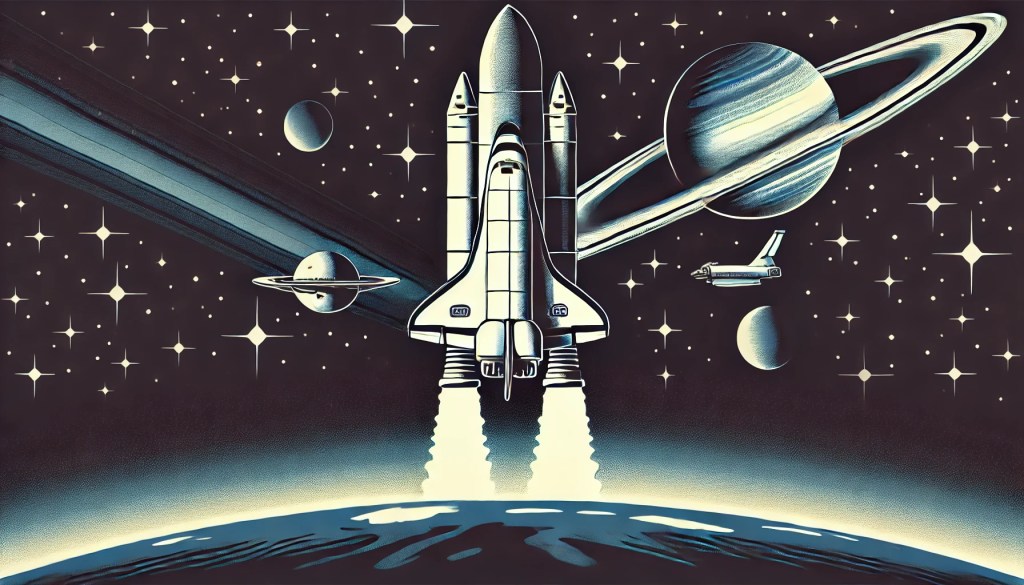
The 1980s marked a transformative period for space exploration, characterized by both remarkable achievements and profound lessons. This decade witnessed the peak of the Space Shuttle program, groundbreaking international collaborations, and technological advancements that laid the foundation for modern space exploration. At the same time, it was a period of sobering reflection, as the Challenger disaster underscored the inherent risks of pushing the boundaries of human capability. The legacy of the 1980s in space exploration is multifaceted, shaping not only the trajectory of NASA and other space agencies but also influencing the private sector and international partnerships in space exploration.
The Space Shuttle: A Symbol of Ambition and Innovation
At the heart of 1980s space exploration was NASA’s Space Shuttle program. The shuttle, first launched in 1981 with the successful flight of Columbia, was heralded as a revolutionary leap forward in space travel. Unlike previous spacecraft, which were single-use, the shuttle was designed to be reusable, capable of carrying large payloads into orbit and returning safely to Earth. Its versatility made it a workhorse for a wide range of missions, from deploying satellites to conducting scientific experiments in microgravity.
Throughout the decade, the shuttle program achieved several milestones. The deployment of the Hubble Space Telescope components (later launched in 1990) began in this era, as did the construction and maintenance of satellites that revolutionized telecommunications and weather forecasting. The shuttle also facilitated international cooperation, carrying payloads and experiments from countries around the world, including Canada, Germany, and Japan. The robotic Canadarm, developed by Canada, became an essential tool for shuttle missions, symbolizing the growing global collaboration in space exploration.
Challenger Disaster: A Turning Point
Despite its successes, the 1980s also highlighted the risks and challenges of space exploration. The Challenger disaster on January 28, 1986, was a defining moment. The shuttle broke apart 73 seconds after liftoff, killing all seven crew members, including Christa McAuliffe, who was set to become the first teacher in space. The tragedy shocked the world and brought NASA under intense scrutiny.
Investigations revealed that the disaster was caused by the failure of an O-ring seal in one of the shuttle’s solid rocket boosters, exacerbated by unusually cold temperatures on the morning of the launch. The subsequent Rogers Commission Report criticized NASA’s organizational culture and decision-making processes, highlighting a lack of effective communication and an underestimation of safety concerns.
The Challenger disaster led to a two-and-a-half-year hiatus in the shuttle program and prompted significant changes in NASA’s approach to safety and risk management. These reforms not only improved shuttle operations but also set new standards for human spaceflight, influencing the policies of other space agencies and private space enterprises in the years to come.
Advancements in Technology and Science
The 1980s saw significant technological advancements that expanded humanity’s understanding of space. NASA and other agencies launched a series of interplanetary missions that provided unprecedented insights into the solar system. The Voyager spacecraft, launched in the late 1970s, continued their journey during the 1980s, sending back stunning images and data from the outer planets. Voyager 2’s encounters with Uranus in 1986 and Neptune in 1989 were historic, revealing detailed information about these distant planets and their moons.
Closer to Earth, satellites launched during this decade transformed global communication and Earth observation. The Landsat program, for instance, provided critical data on land use, deforestation, and climate change. Weather satellites launched in the 1980s improved forecasting accuracy, helping to save lives and reduce economic losses caused by natural disasters.
The decade also saw the beginnings of efforts to establish permanent human presence in space. Although the International Space Station (ISS) would not be completed until the 2000s, the 1980s laid the groundwork for this achievement. Space Shuttle missions conducted experiments in microgravity that advanced our understanding of materials science, biology, and human physiology in space—knowledge that would later prove essential for long-duration spaceflight.
International Collaboration: A Global Effort
One of the most enduring legacies of the 1980s was the strengthening of international collaboration in space exploration. While the Cold War rivalry between the United States and the Soviet Union defined the early years of the space race, the 1980s saw a shift toward cooperation.
The European Space Agency (ESA) emerged as a significant player in space exploration during this decade, launching the Ariane rocket series and contributing scientific instruments to NASA missions. The Soviet Union continued its own ambitious space program, operating the Salyut and Mir space stations. Mir, launched in 1986, became a symbol of Soviet technological prowess and a precursor to the ISS, eventually hosting astronauts from multiple countries.
In 1985, President Ronald Reagan announced plans for the ISS, inviting international partners to participate. This vision of a shared space platform symbolized a move toward peaceful cooperation in space, reflecting broader geopolitical changes as the Cold War began to wind down.
Influence on Popular Culture
The 1980s also saw space exploration become deeply embedded in popular culture. The shuttle program captured public imagination, inspiring countless books, movies, and television shows. Films like The Right Stuff (1983) and SpaceCamp (1986) celebrated the bravery and ingenuity of astronauts, while science fiction franchises like Star Wars and Star Trek reflected humanity’s enduring fascination with the cosmos.
Space exploration was also a frequent subject in education and outreach. NASA’s efforts to engage the public, such as the Teacher in Space program that tragically included Christa McAuliffe, demonstrated a commitment to inspiring the next generation of scientists and engineers. Space-themed toys, video games, and educational programs further cemented space exploration’s place in the cultural zeitgeist of the decade.
The Legacy of the 1980s
The 1980s left an indelible mark on the history of space exploration. The decade’s achievements demonstrated the potential of human ingenuity and international cooperation, while its setbacks underscored the importance of safety and humility in the face of the cosmos’ challenges. The technological advancements and scientific discoveries of this era laid the groundwork for future exploration, from the ISS to Mars rovers and beyond.
Moreover, the lessons learned during the 1980s continue to shape the policies and practices of space exploration today. The emphasis on safety, the value of international collaboration, and the drive to push the boundaries of knowledge remain central to humanity’s efforts to explore the final frontier. In many ways, the legacy of the 1980s in space exploration is not confined to history; it is an ongoing story, with new chapters being written every day.

 Totally Retro: 80s Edition
Leave a comment