Professional wrestling in the 1980s was a spectacle unlike anything before it, a lawless battlefield where larger-than-life characters, unbridled showmanship, and cutthroat business tactics transformed the industry forever. At the heart of this transformation stood one man: Hulk Hogan. His meteoric rise, coupled with the emergence of the World Wrestling Federation (WWF) under the shrewd leadership of Vince McMahon, and the birth of WrestleMania, cemented professional wrestling as a mainstream phenomenon. The decade was defined by intense rivalries, territorial battles, and a complete reinvention of what wrestling could be in the eyes of the public. It was a time when wrestling was no longer confined to small arenas and local television broadcasts—it was becoming a national empire fueled by the charisma of its superstars and the relentless ambition of those behind the scenes.
Hulk Hogan’s rise to superstardom was nothing short of cinematic. Originally trained by Hiro Matsuda, Hogan first gained attention in the late 1970s in smaller promotions before making his way to the then-World Wide Wrestling Federation (WWWF). However, it wasn’t until his role in Rocky III as Thunderlips, a flamboyant and seemingly invincible wrestler, that Hogan’s larger-than-life persona truly began to take shape. Fans were captivated by his charisma, his impressive physique, and his undeniable presence. But it was Vince McMahon who saw something even bigger in Hogan—something that could carry professional wrestling into an entirely new era. When Hogan returned to the WWF in 1983, he was immediately positioned as the face of the company, and within months, he won the WWF Championship from the Iron Sheik in January 1984, launching what would become known as the Hulkamania era.
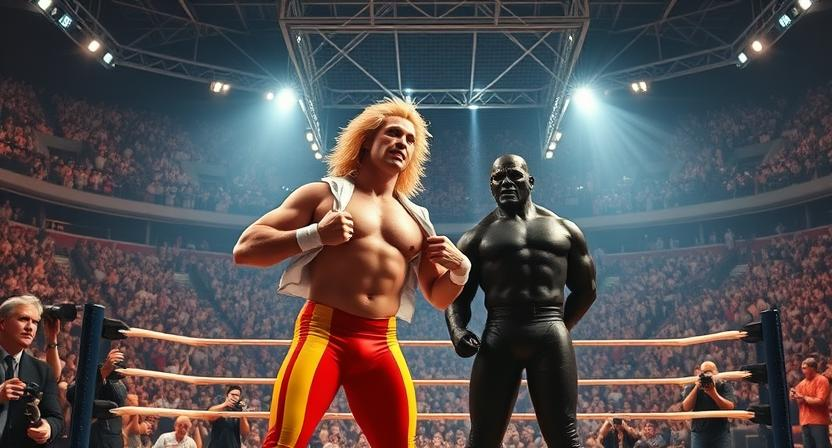
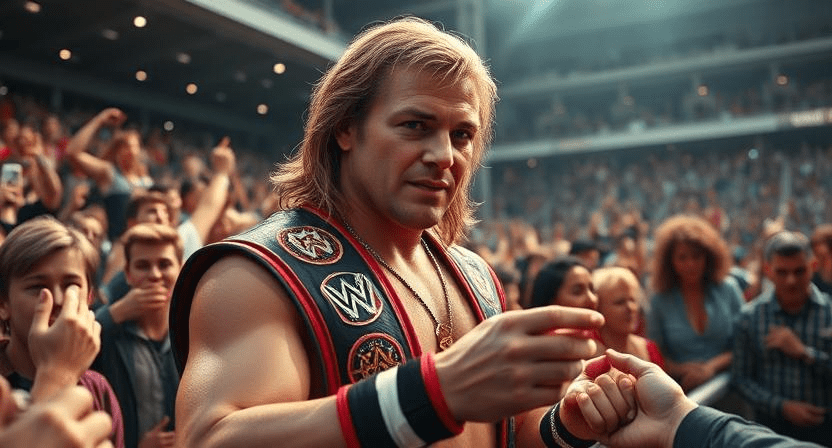
Hulkamania was more than just a marketing gimmick; it was a cultural movement. With his trademark red and yellow gear, his heroic persona, and his oft-repeated mantra of training, saying prayers, and taking vitamins, Hogan appealed to both children and adults alike. His matches often followed a familiar formula: he would endure a brutal beatdown from his opponent, only to summon an almost supernatural second wind, shaking with adrenaline as he “Hulked up” and made a dramatic comeback. His finishing move, the leg drop, was simple yet devastating, a perfect exclamation point on the scripted heroics that made him a global icon. Merchandise sales skyrocketed as fans donned Hulk Hogan T-shirts, bandanas, and foam championship belts. His impact reached beyond the wrestling ring, appearing on talk shows, cartoons, and movies, making him one of the most recognizable figures of the 1980s.
But Hulk Hogan’s rise was only one piece of a much larger puzzle. Vince McMahon, the mastermind behind the WWF, was orchestrating a seismic shift in the wrestling world. Historically, professional wrestling was a territorial business, with various regional promotions operating independently under the umbrella of the National Wrestling Alliance (NWA). These promotions respected each other’s territories and rarely crossed paths. However, McMahon had a different vision—one that involved national expansion, cable television, and mainstream entertainment. His strategy was bold and aggressive: he began raiding talent from rival promotions, securing exclusive television deals, and producing larger-than-life wrestling events that resembled Hollywood productions rather than traditional wrestling shows.

The coup de grâce of McMahon’s vision came in 1985 with the debut of WrestleMania. Inspired by the success of closed-circuit boxing events and the Super Bowl’s grandeur, McMahon envisioned a wrestling spectacle that would combine the best elements of sports and entertainment. The first WrestleMania, held at Madison Square Garden, was a high-stakes gamble. McMahon poured everything into its promotion, securing mainstream celebrities like Muhammad Ali, Cyndi Lauper, and Mr. T to generate crossover appeal. The main event, featuring Hulk Hogan and Mr. T against Roddy Piper and Paul Orndorff, was a spectacle designed to draw the biggest possible audience. The risk paid off, as WrestleMania became a financial and cultural success, laying the foundation for an annual event that would grow larger with each passing year.
WrestleMania’s success solidified the WWF as the dominant force in professional wrestling. With the ability to attract mainstream celebrities, secure lucrative sponsorships, and expand globally through pay-per-view, McMahon’s empire was nearly untouchable. Competitors such as the NWA and the American Wrestling Association (AWA) struggled to keep pace, unable to match the sheer scale of the WWF’s production. The Rock ‘n’ Wrestling Connection, spearheaded by McMahon’s partnership with MTV, further elevated wrestling into mainstream pop culture. Superstars like Randy Savage, The Ultimate Warrior, and Andre the Giant became household names, each playing a pivotal role in the WWF’s storytelling machine. The 1980s became the golden age of wrestling storytelling, where heroes and villains were clearly defined, and matches were built with months of anticipation.
While Hulk Hogan was undeniably the centerpiece, the 1980s were filled with legendary rivalries that contributed to the WWF’s explosive growth. One of the most iconic feuds of the decade was Hulk Hogan vs. Andre the Giant. Their legendary clash at WrestleMania III in 1987, where Hogan bodyslammed the 520-pound Andre, became one of the most defining moments in wrestling history. Another unforgettable rivalry was Hogan’s battles against “Macho Man” Randy Savage, a storyline that weaved through alliances, betrayals, and championship glory, culminating in their WrestleMania V showdown. Meanwhile, The Ultimate Warrior emerged as the next larger-than-life figure, eventually dethroning Hogan at WrestleMania VI in 1990, symbolizing a shift in the WWF’s landscape.
Despite its unprecedented success, the WWF’s dominance in the 1980s wasn’t without controversy. The industry’s rapid expansion led to allegations of steroid abuse, backstage politics, and conflicts with rival promotions. Wrestlers worked grueling schedules, performing nearly 300 days a year, leading to physical and mental exhaustion. Vince McMahon’s aggressive tactics alienated many traditional promoters, fueling an ongoing war with the NWA and other competitors. However, these struggles did little to slow the WWF’s momentum as the decade came to a close.
By the end of the 1980s, professional wrestling had evolved from a niche attraction into a global spectacle. The WWF had redefined what was possible in the business, elevating sports entertainment to new heights. Hulk Hogan remained the face of the industry, a larger-than-life figure whose influence extended beyond wrestling itself. WrestleMania had become the Super Bowl of professional wrestling, drawing millions of viewers each year. The WWF’s success in the 1980s paved the way for future generations of wrestlers, promotions, and fans, setting the stage for the wrestling boom of the 1990s and beyond.
The 1980s were truly the Wild West of professional wrestling, a time of unchecked ambition, larger-than-life personalities, and unprecedented transformation. It was an era defined by risk-taking, storytelling, and spectacle—where the business was forever changed by those bold enough to bet everything on the belief that wrestling could be more than just a regional attraction. Vince McMahon, Hulk Hogan, and WrestleMania didn’t just change wrestling; they changed entertainment as a whole. And for fans who lived through it, the memories of that decade remain as vivid and electric as the day they first witnessed Hulk Hogan rip his shirt, cup his hand to his ear, and embody the pure magic of professional wrestling.

 Totally Retro: 80s Edition
Leave a comment