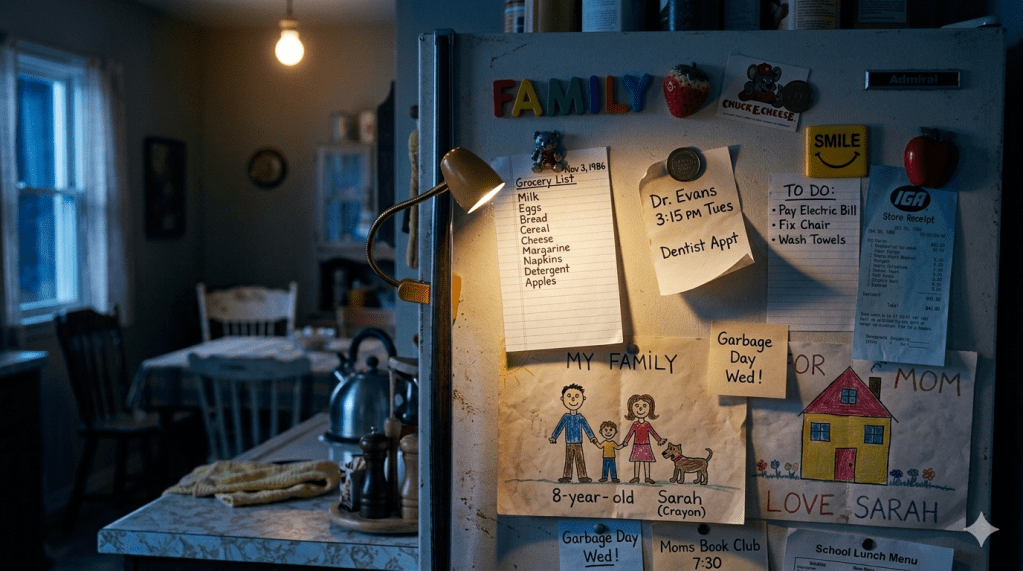
A Living Surface
Before anything was saved, backed up, or synchronized, there was the refrigerator door. It stood in the center of the kitchen like a quiet, constant presence—something passed a dozen times a day without notice, until attention finally settled on it. Then it stopped being background and became something else entirely: a surface slowly transformed into memory.
Covered in magnets and filled with all items—notes, pictures, receipts—it constantly shifted, holding the quiet record of everyday life. Nothing was designed to last there, and yet everything did, at least for a while. The door did not organize life. It simply displayed it, all at once, without hierarchy, without filtering, without asking permission. Over time, it became less like a utility and more like a quiet witness to the household.
How It Started
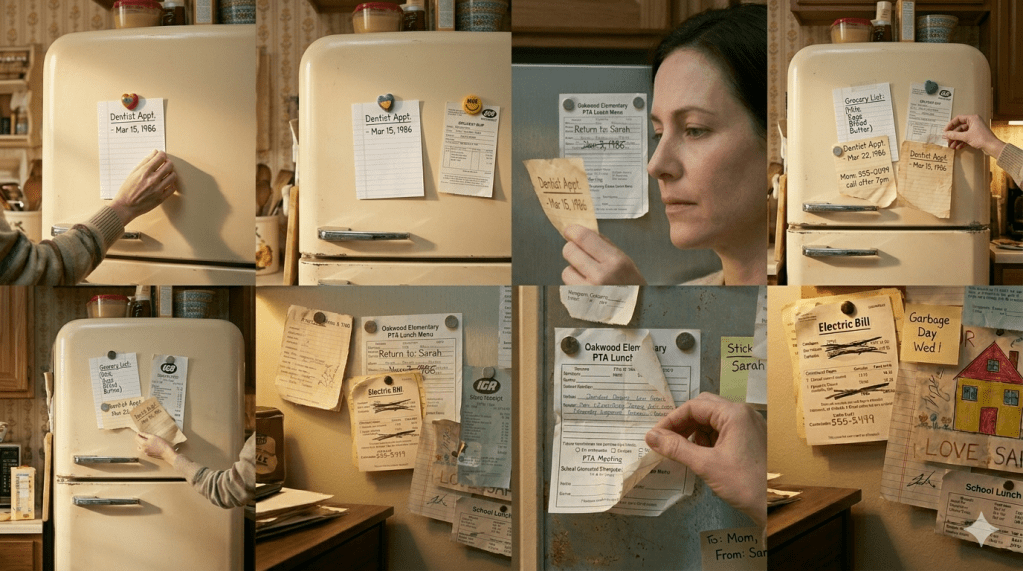
The fridge door did not begin as something meaningful. It began with small, practical gestures that seemed too ordinary to matter in the moment they were made. A grocery list written in a rush before leaving the house, often half-remembered items added as the pen hovered over the page. A reminder scribbled on the back of an envelope because there was nothing else within reach. A school notice pinned up so it would not be forgotten in the morning chaos, even though it was already half read and partially understood. A receipt tucked under a magnet with the vague intention of “dealing with it later,” even when later never had a clear shape or time.
There was no sense that these things belonged together. Each one was created for a specific, immediate purpose, tied to a single task, a single day, a single need. Yet they all ended up in the same place, drawn to the refrigerator door simply because it was the most convenient surface in the house. Over time, that convenience became habit, and habit quietly turned into accumulation.
None of these items carried weight on their own. A grocery list meant nothing once the groceries were bought. A reminder lost urgency as soon as the appointment passed. A school notice became irrelevant once it was signed and returned. But the fridge door had no mechanism for removal based on relevance. It did not evaluate usefulness or expiry. It simply accepted what was placed on it, and in doing so, treated everything as equally worth keeping in view.
That equality changed the surface. Over days and weeks, the door began to thicken visually, not in material but in meaning. Papers overlapped in uneven layers. New notes were placed over older ones without any deliberate decision to clear space first. Corners lifted slightly as magnets shifted under the weight of addition. What started as a practical system for keeping track of small tasks slowly became a physical record of time passing in place.
And still, no one noticed the moment it changed. There was no point at which it became “an archive.” No decision was made to preserve anything. It simply formed through repetition—through the quiet return to the same surface, the same habit, the same gesture of placing something temporary somewhere visible.
Notes That Outlived Their Purpose
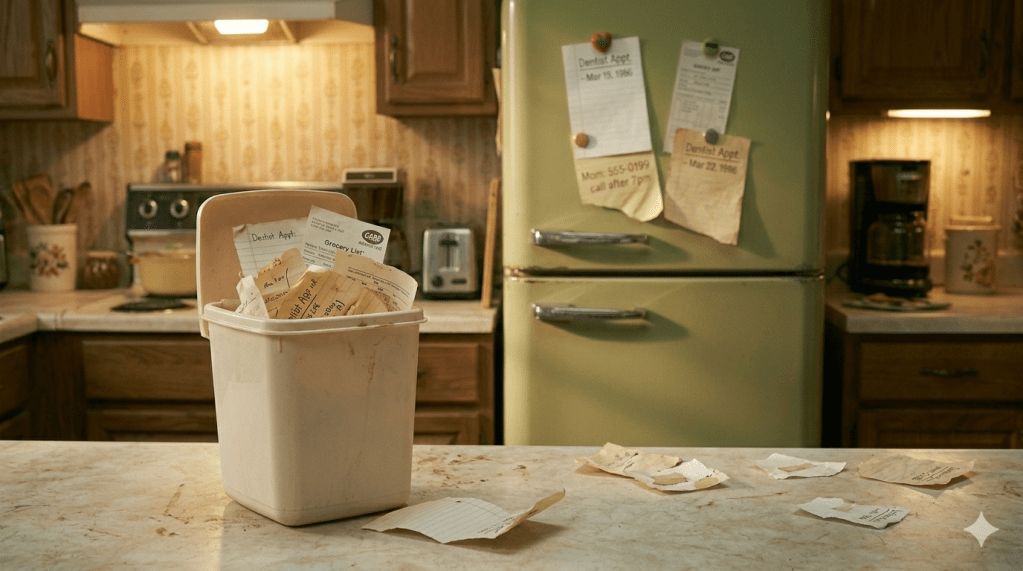
Some pieces of paper remained long after their usefulness had quietly expired. A dentist appointment reminder stayed pinned weeks after the visit had already passed, still occupying the same small corner of the door as if nothing had changed. A delivery slip lingered even after the package had been opened, unpacked, and folded into memory, the contents already integrated into daily life and no longer thought about. A handwritten phone number remained in place simply because no one was entirely sure it should be removed, and uncertainty was often enough to justify keeping it there.
These were not dramatic holdovers. They did not announce themselves or demand attention. Instead, they faded into the background of the door, becoming part of its texture. You could look directly at them and still not really see them, the way familiar objects stop being noticed even when they remain in plain sight.
There was a subtle hesitation behind removing anything. A quiet, almost invisible pause before action. Taking something down felt slightly final in a way that didn’t match the simplicity of the act. It wasn’t just paper being removed—it felt like closing off a small piece of time, a decision that might erase not only the task itself, but the brief moment in life when that task mattered enough to write down in the first place.
So instead, things stayed. Not because they were still relevant, and not because anyone believed they would become relevant again, but because they had once been relevant. That past importance was enough to grant them a kind of temporary permanence that quietly stretched far beyond its intended lifespan.
Over time, the fridge door developed its own slow logic. Nothing left immediately, and nothing left cleanly. Items accumulated in place, not through intention but through delay. And in that delay, something shifted. The door stopped being a surface for reminders and became something closer to a holding space for unfinished time—where small fragments of life remained visible long after their purpose had passed, simply because no one ever made the exact right moment to take them away.
Children, Paper, and the First Sense of Permanence
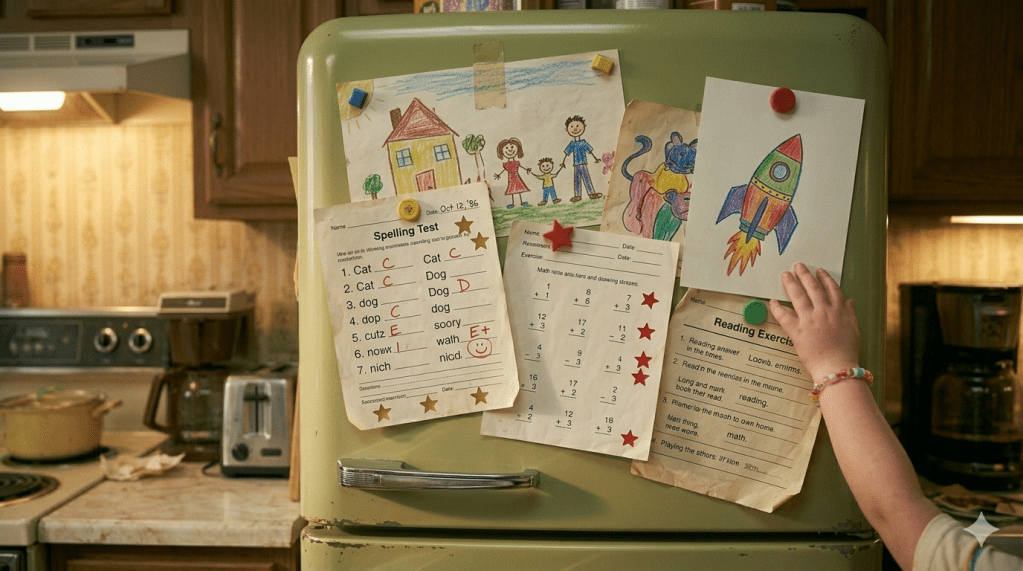
For children, the fridge door was not a storage space—it was a stage where things became real in a way that felt immediate and unquestioned. Drawings appeared without ceremony, taped or magneted into place with full confidence, often held up to be seen first before they even reached the door. Crayon lines formed houses, people, animals, and abstract shapes that didn’t need interpretation to matter. The value was not in accuracy or skill, but in the fact that they existed and had been chosen for display.
School worksheets arrived with a similar weight attached to them. Even when they were covered in red ink corrections or marked with small gold stars, they were still placed on the door with a sense of pride. Spelling tests, math sheets, reading exercises—all of them became part of the same visible surface, regardless of performance. What mattered was not how well they were done, but that they had been done and acknowledged.
These were not temporary items in the way adult notes were. Adults tended to treat paper as functional—something that served a purpose and then disappeared once that purpose was complete. Children, however, experienced something different. Once their work reached the fridge door, it often stopped feeling temporary at all. It became part of the environment. Part of the household. Part of what the kitchen “looked like.”
A drawing did not need to be useful to remain visible. A test did not need to be current to stay up. There was no internal system of review or removal from their perspective. Visibility itself became the measure of importance, and the door quietly reinforced that idea every day it remained unchanged.
Over time, this created an early, unspoken lesson about permanence. Not permanence in the abstract sense, but permanence as something physical and observable: if something stayed in place, it continued to matter. If it remained visible, it still held value. And if it was taken down, it did not necessarily disappear—it simply stopped existing in that shared space.
In that sense, the fridge door became one of the earliest places where permanence was learned not through explanation or instruction, but through repetition and observation. It taught without intending to. A surface meant for convenience gradually became a quiet teacher of what it meant for something to last.
Magnets as Unintentional Records
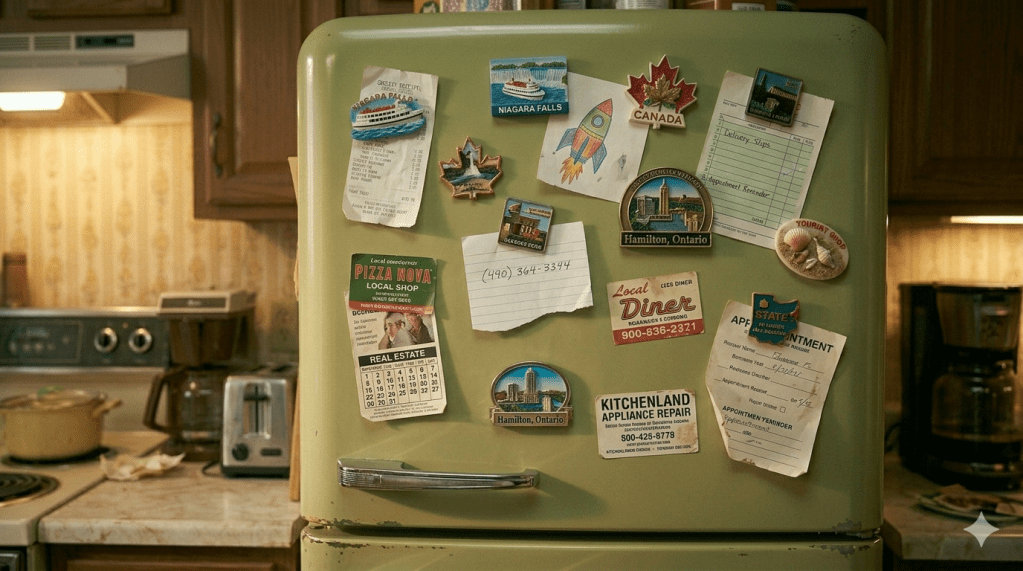
The magnets holding everything in place were never chosen as a set. They were not planned, coordinated, or designed to match. Instead, they arrived one by one, collected slowly over years without any real intention behind them. Each one came from a different moment, a different place, a different small decision that felt insignificant at the time.
A souvenir from a roadside stop during a summer drive, picked up almost absentmindedly and later placed on the fridge without much thought. A promotional magnet from a local business, handed over with change or tucked into a bag after a purchase. A small plastic shape from a tourist shop, chosen more for habit than meaning. A pizza place logo that faded slightly at the edges but never disappeared, even after the number stopped being used regularly.
None of them were special on their own. In isolation, they were just objects—light, cheap, easily forgotten. But over time, they began to accumulate in the same place, held together not by design but by repetition. The fridge door became the default destination for anything magnetic, and so the collection grew without anyone ever deciding to build it.
Each magnet represented movement outside the home, even if only briefly. A trip taken and then returned from. An errand run on an ordinary afternoon. A phone call made to someone local, followed by a small interaction that ended with a physical object as proof. They were not souvenirs in the traditional sense of memory preservation, but they still carried traces of place and moment, even if no one thought about it that way at the time.
Together, they formed a quiet collection of reminders about everyday life. Not milestones, not significant events, but the smaller movements in between—the ordinary circulation of days that rarely gets recorded anywhere else.
The fridge door turned these fragments into something stable. What would otherwise have been scattered or forgotten became anchored in one visible space. A collection of objects held together by habit rather than intention, slowly building a presence that no one actively maintained, but everyone continued to add to.
The Layering of Time
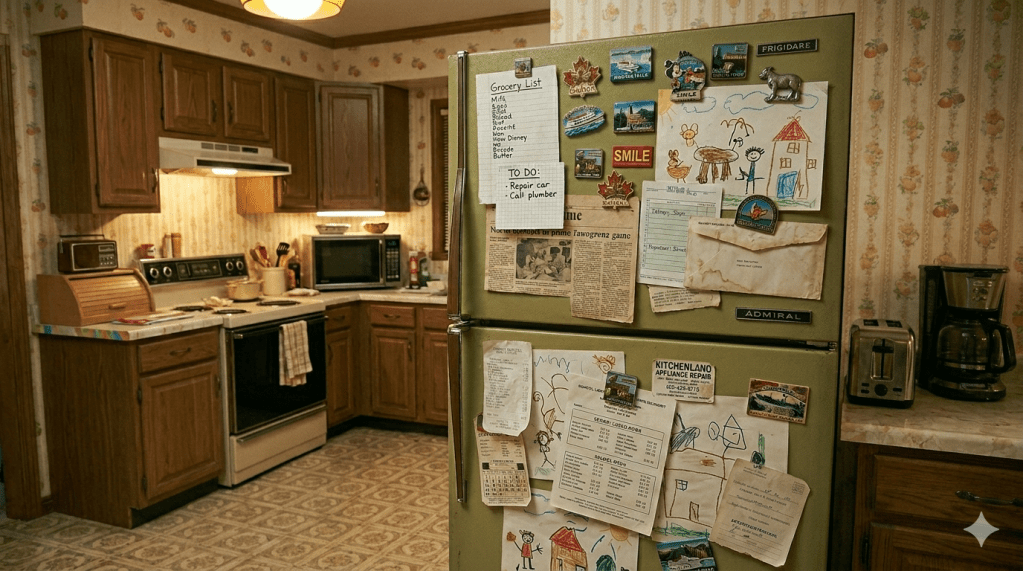
As time passed, the surface became denser, not just with objects, but with overlapping versions of time itself. Paper stacked on paper in uneven layers, each one added without fully acknowledging what was already there. Ink faded at different rates depending on where light reached the door and how long it had been exposed. Tape yellowed but still held, doing its job long past the point where it looked new. Corners of paper curled upward slightly, as if resisting the attempt to keep everything flat and contained.
Nothing was reset. Nothing was cleared back to zero. There was no moment where the surface was emptied or reorganized in any meaningful way. Instead, it simply continued to build on itself. The past was never removed—it was only pushed downward, gradually covered by whatever came next. Older notes remained underneath newer ones, still there in principle, even if no longer easy to see or read.
This created a kind of quiet layering where multiple moments coexisted in the same small space. A grocery list from last week might sit behind a school notice from this week. A reminder about an appointment could be partially hidden by a drawing placed over it without hesitation. Things were not replaced so much as they were obscured. Nothing disappeared completely, but not everything stayed visible either.
The result was not order, and it was not chaos either. It was something more specific to the space itself—a physical depth created by repetition. The fridge door did not organize time into categories or sequences. It allowed time to accumulate in place, without sorting or separating it.
What made it unusual was that this layering was not seen as clutter at the time. There was no sense that anything needed to be fixed or simplified. It was simply how the surface functioned. Life continued, and the door absorbed it, one layer at a time, without interruption or reflection.
A Silent Communication System
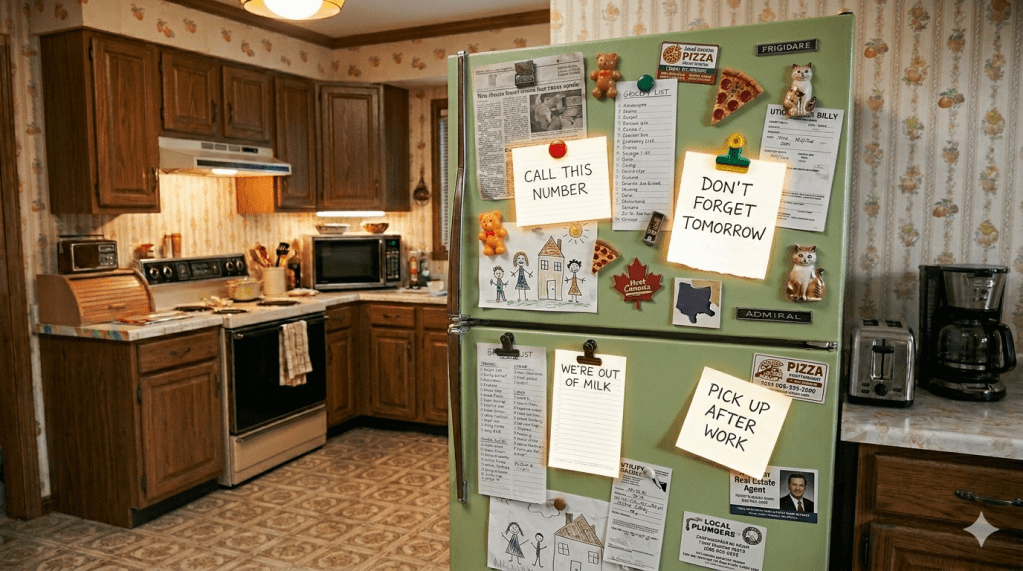
Without any planning or formal decision, the fridge door slowly became the household’s communication center. It was not introduced as one, and no one ever referred to it in those terms, but over time it naturally took on that role. Messages were left not for conversation, but for coordination. Short, direct instructions that existed purely to make daily life function. “Call this number.” “Don’t forget tomorrow.” “We’re out of milk.” “Pick up after work.” Simple statements written quickly, often without punctuation or concern for presentation, just enough to ensure they would be understood at a glance.
These messages did not invite response in the way modern communication does. There were no replies, no threads, no confirmation that something had been seen. Once placed on the door, the message simply existed in shared space, waiting to be noticed at the right moment. If it was read, it was understood. If it was acted on, the system worked. If not, it remained there until it was either no longer relevant or quietly replaced by something newer.
Everyone passed it repeatedly throughout the day without thinking about it. The fridge door sat in a natural path of movement through the kitchen, making it unavoidable in a way that required no effort or intention. It needed no shared device, no login, no passwords, no notifications, and no setup. It did not depend on synchronization or timing between people. It was simply always there, always visible, always waiting at the same height in the same place.
In that way, it became a shared memory system built entirely on presence. Information did not travel between devices or accounts; it stayed in one physical location that everyone encountered. It worked not through alerts or reminders, but through repetition and visibility. The act of walking past it became the act of remembering.
If something was placed on the door, it was effectively remembered for the household. If it was not placed there, it risked being forgotten entirely. Memory was not internal or digital—it was spatial. It depended on where something was put, not how important it was.
What Time Looked Like on Paper
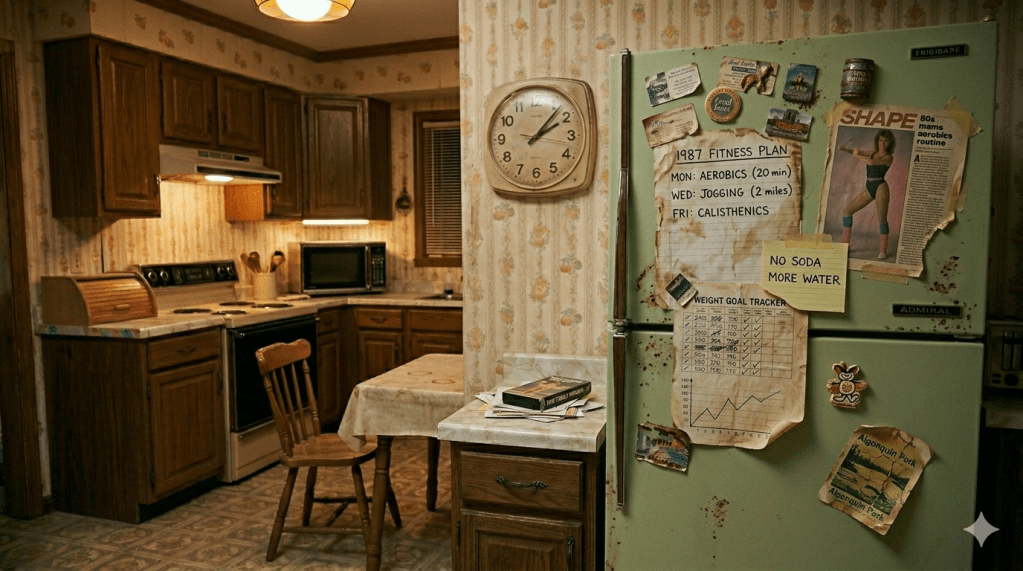
Time revealed itself indirectly, never in a single clear sign, but in small changes that only became noticeable when looked at together. Handwriting shifted slightly over the years, sometimes becoming looser, sometimes more rushed, sometimes more careful, reflecting no deliberate change but simply the passing of habit and age. Phone numbers grew longer as systems expanded and formats changed, quietly marking updates in something as ordinary as contact information. Paper itself changed too—from lined notepads torn quickly from a pad, to printed sheets pulled from a home printer, to scraps of whatever was closest at hand when something needed to be written down quickly.
Even the materials that held everything in place changed without notice. Magnets softened in color after years of constant exposure to light and repeated handling, their surfaces worn down not by use in any direct sense, but by simply being there for too long. Tape lost its clarity, edges frayed slightly, and corners of paper curled in ways that suggested time not as movement, but as exposure.
None of this was obvious in isolation. A single note fading meant very little on its own. A slightly different handwriting style could easily go unnoticed from one day to the next. But together, these small variations built something more coherent. They formed a quiet, unspoken record of time passing not through dates or labels, but through physical change in ordinary objects.
The fridge door did not label time or organize it into periods. It did not separate years or mark transitions. Instead, it simply showed time as something that happened to things that stayed in one place long enough. It revealed time indirectly, through accumulation, wear, and repetition—through the slow transformation of the everyday surface it held together.
What Disappeared Quietly
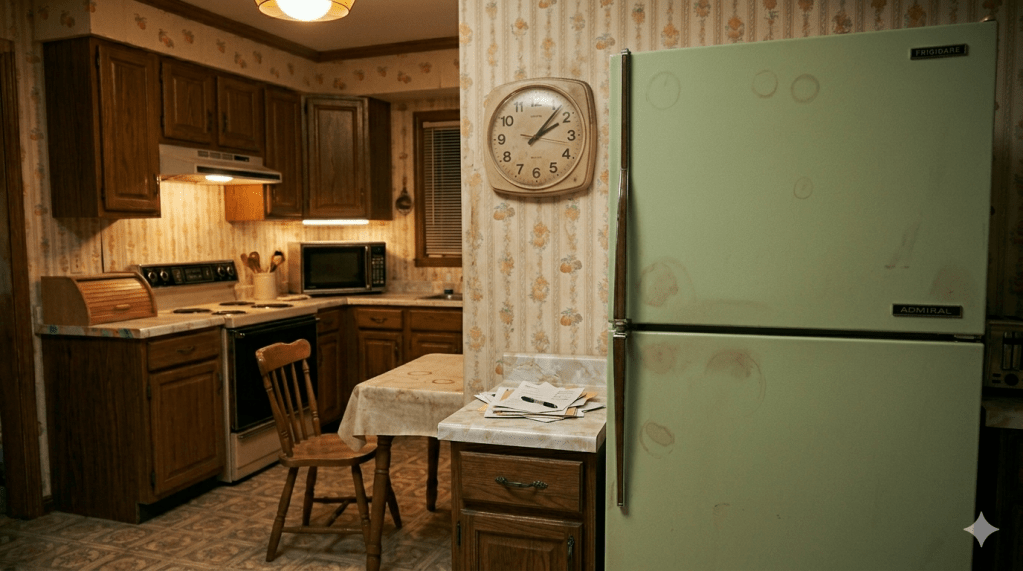
Eventually, things came down without notice or ceremony. There was no announcement, no clear decision point, and often no shared awareness that something had been removed at all. A note slipped behind the fridge and was never retrieved, disappearing into a space that was out of reach and, eventually, out of mind. A drawing was replaced by a newer one and never reattached, not because it was unimportant, but because attention simply moved forward. A list was thrown away after its purpose faded so completely that no one remembered keeping it in the first place, let alone what was written on it.
These removals rarely felt like events. They happened in passing, often while doing something else, without pause or reflection. One moment an item was part of the surface; the next, it was gone, leaving no obvious gap behind. The system absorbed the absence so smoothly that it rarely registered as loss. The door did not feel emptied—it simply continued as it was, slightly rearranged.
There was no clear moment of loss. Things did not leave dramatically, and they were not usually missed in real time. Instead, they simply stopped being present, and absence replaced them without drawing attention to itself. In a space where visibility defined importance, what was not visible gradually ceased to exist in any active sense.
And because of that, disappearance did not always feel significant. It did not carry weight or interruption. It felt natural, almost expected, as if things were always moving in and out of visibility at a quiet, steady pace that no one needed to track closely.
What remained was always just what happened to be visible at that moment—the current layer of life, temporarily stable, holding everything that had not yet been moved, removed, or forgotten.
What Replaced It Today
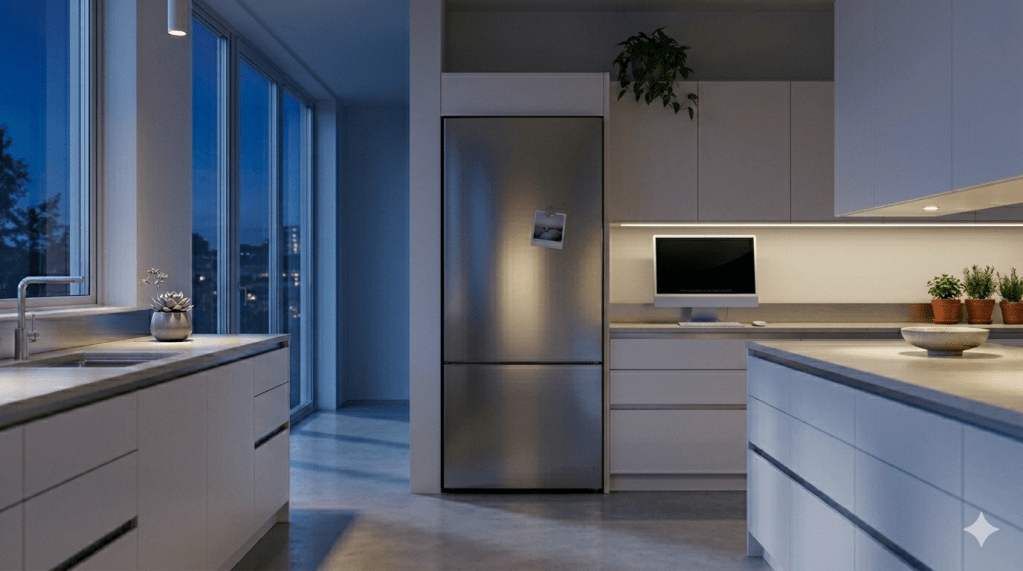
Now, the surface is often empty. Clean, minimal, almost erased. The same functions still exist, but they have migrated elsewhere—inside phones, apps, and notifications that appear and vanish without leaving any physical trace. Nothing overlaps anymore. Nothing curls at the edges. Nothing quietly stays longer than it should.
Reminders are no longer shared spaces; they are private alerts. A grocery list lives in a phone that only one person might check. A school notice arrives as an email. A photo that once would have been pinned to a door is now stored in a gallery that may never be opened again. Everything is still recorded, but nothing is collectively visible.
What has changed is not just the medium, but the atmosphere. The fridge door was slow, passive, and constantly present. It could not hide what was important because everything important had to live in the same small space. Today’s systems are faster, cleaner, and more efficient—but also more fragmented. Memory is no longer something you pass on your way to the kitchen table. It is something you scroll past alone.
What is missing is not information, but presence. The fridge door did not organize life. It displayed it in real time, without editing, without selection. And in doing so, it accidentally became something no system has fully replaced: a visible, shared memory of being at home.


Leave a Reply