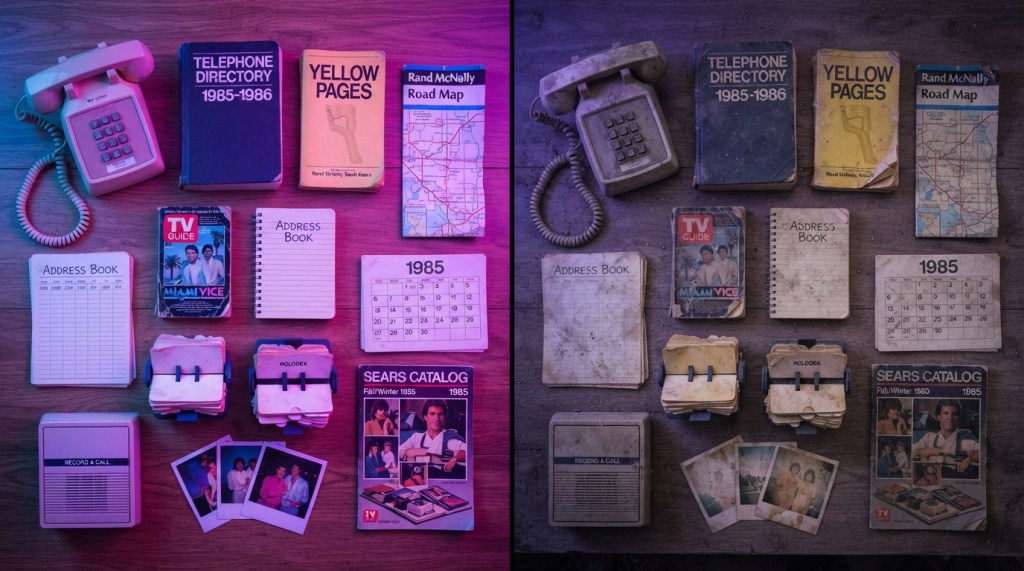
There are plenty of things that people associate with the 1980s. Walkmans, arcade machines, VHS tapes, boomboxes, Rubik’s Cubes, cassette tapes, neon clothing and video games all come to mind almost immediately. They are the things that usually appear in photographs and nostalgia articles about the decade.
But some of the most interesting reminders of the 1980s are not the things people collected, played with or deliberately bought because they were considered cool. They were the ordinary things that were simply part of everyday life. They were sitting in kitchens, hanging beside telephones, stored in cars, lying on desks, sitting beside televisions and waiting in stores. Nobody thought of them as “retro” because nobody had any reason to believe they would eventually disappear.
If you could somehow walk into an ordinary Canadian or American home in 1985, you would see many things that would look completely normal to someone living at the time but surprisingly strange today. There might be several thick books beside the telephone. A paper calendar could be hanging on the wall. The television listings might be sitting on the coffee table. There could be an ashtray nearby even if nobody in the house smoked. A stack of catalogues might be sitting beside the sofa, and an address book could be open on a desk.
The really interesting thing is that many of these objects weren’t replaced by better-looking versions of themselves. They simply became unnecessary. Technology changed the way people found information, communicated, shopped, travelled, watched television, stored photographs and kept records. One by one, the objects that supported those activities became less important.
Some disappeared quickly. Others hung around for years before becoming unusual. A few can still be found today, but they have gone from being ordinary household items to things that immediately make a place feel like another era.
Here are some of the things that were everywhere in 1985 that you almost never see now.
Phone Books
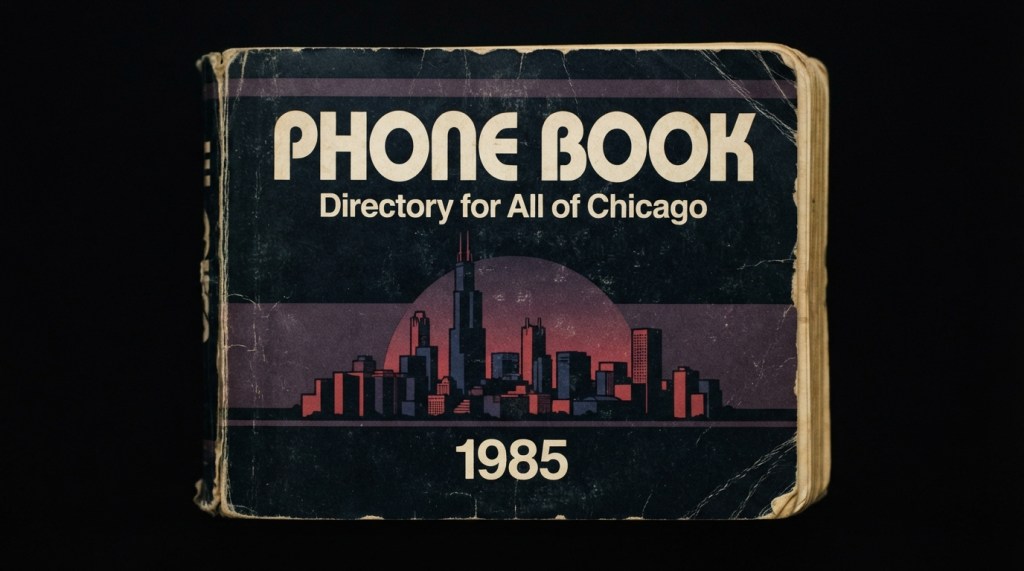
One of the biggest books in many homes was not a novel, cookbook or encyclopedia. It was the telephone directory.
A phone book could be surprisingly thick, depending on where you lived. It contained page after page of names, addresses and telephone numbers, usually printed in very small type. In a larger community, the directory could be substantial enough that you would probably never want to carry it around unless you absolutely had to.
The important thing was that the phone book was useful. If you wanted to call someone, but didn’t know their number, you looked them up. If you needed to find a local business, you could search for it. If somebody gave you a phone number but you weren’t sure who it belonged to, the directory could sometimes help you figure it out.
There was something almost physical about searching for information this way. You had to know what you were looking for, turn to the correct section and scan the pages. You might run your finger down a column of names until you found the right one. If you were looking for a business, you had to find the appropriate category and then work your way through the listings.
Phone books also had a very specific place in the home. They were often kept beside the telephone because that was where they were needed. A household telephone table might have a phone book sitting underneath the phone, sometimes accompanied by a notepad and pen. You could reach for the directory while talking to someone and look up another number without ever leaving the conversation.
Today, a phone book feels almost unnecessary. We carry enormous databases of telephone numbers in our pockets, and search engines can find businesses almost instantly. The idea of keeping a giant book containing the phone numbers of an entire community seems strange now. Yet in 1985, it was such a normal part of life that most people barely noticed it.
The Yellow Pages
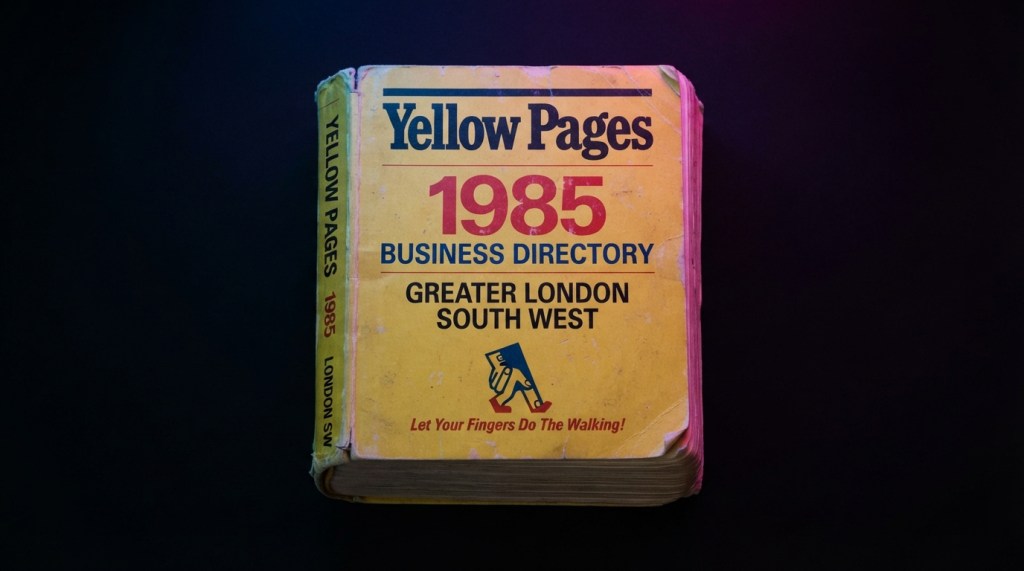
The Yellow Pages deserve their own place because they served a different purpose from the regular telephone directory.
If you needed a plumber, dentist, restaurant, electrician, appliance repair shop, furniture store or almost any other business, the Yellow Pages were one of the places you went first. Instead of searching for a person’s name, you searched by category.
The pages were filled with advertisements. Some businesses had tiny listings containing little more than a name and phone number. Others paid for larger advertisements with bold lettering, photographs, slogans and sometimes illustrations. A larger advertisement could stand out dramatically from the surrounding small print.
The Yellow Pages were particularly important because businesses had to make themselves visible in a world without internet search results. A company could not simply create a website and wait for people to find it. It needed a physical presence in the directory, a recognizable name, an advertisement or some other way of getting customers to notice it.
The book itself became part of the household. It might live beside the telephone, underneath the regular phone book, or in a drawer where everyone knew to look for it. It was often opened with a specific purpose and then forgotten again until the next time something broke or somebody needed a service.
Today, someone who needs a plumber might simply search on their phone and immediately see businesses, reviews, photographs, hours and directions. In 1985, you could be sitting at your kitchen table with a huge yellow book open in front of you, comparing advertisements and writing down telephone numbers.
That change is easy to overlook because searching for a business feels like such a basic activity. But the entire process was once physical.
Paper Maps in the Car
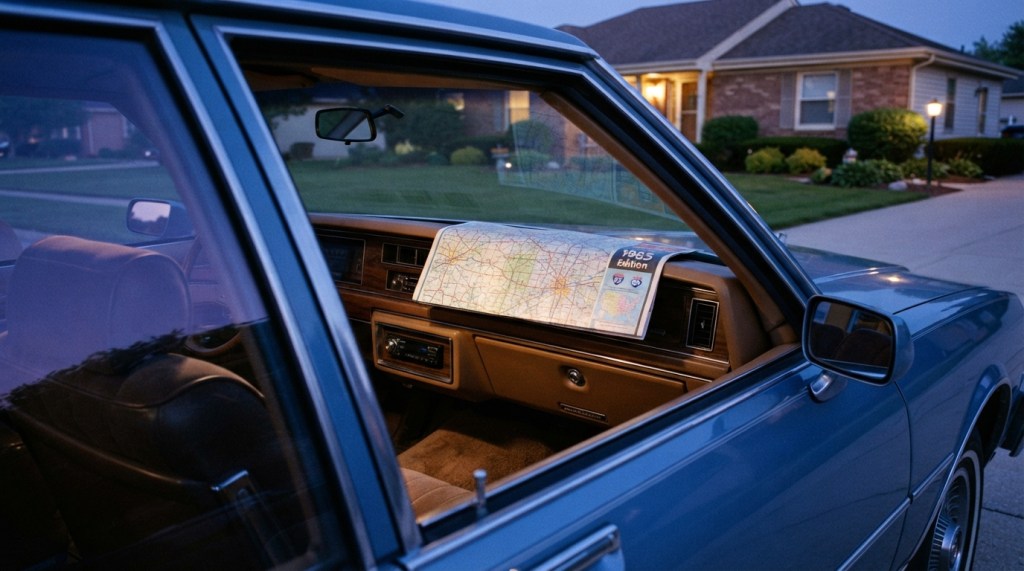
Getting lost in 1985 was different.
There was no smartphone sitting in the cup holder telling you exactly where you were. There was no voice coming from a dashboard screen calmly announcing that you should turn left in 300 metres. If you were driving somewhere unfamiliar, you needed to know where you were going before you left or figure it out along the way.
That meant paper maps.
Many cars had a folded road map tucked into a glove compartment, door pocket or centre console. Some people had larger maps covering an entire province or state. Road atlases were also common, particularly for longer trips.
Using one wasn’t always easy. A map had to be unfolded, sometimes several times, until it became an enormous sheet of paper that seemed determined to fold itself back up. The driver couldn’t safely study it while driving, so somebody else in the car often became the navigator.
This created a very different kind of road-trip experience. You might hear someone say, “We’re coming up to the highway. Which way do I go?” The passenger would unfold the map and try to figure out exactly where the car was. Sometimes the map was upside down. Sometimes the road you needed wasn’t as obvious as you expected. Sometimes you simply missed the turn and had to find another way.
Maps weren’t disposable objects, either. A good map could remain in a car for years. It might become worn around the folds, acquire little tears and collect pencil marks showing favourite routes or destinations.
Today, paper maps still exist, but for most everyday driving they have become unnecessary. That makes an old folded road map surprisingly nostalgic. It represents a time when getting somewhere required a little more preparation and a little more trust in your own sense of direction.
TV Guides
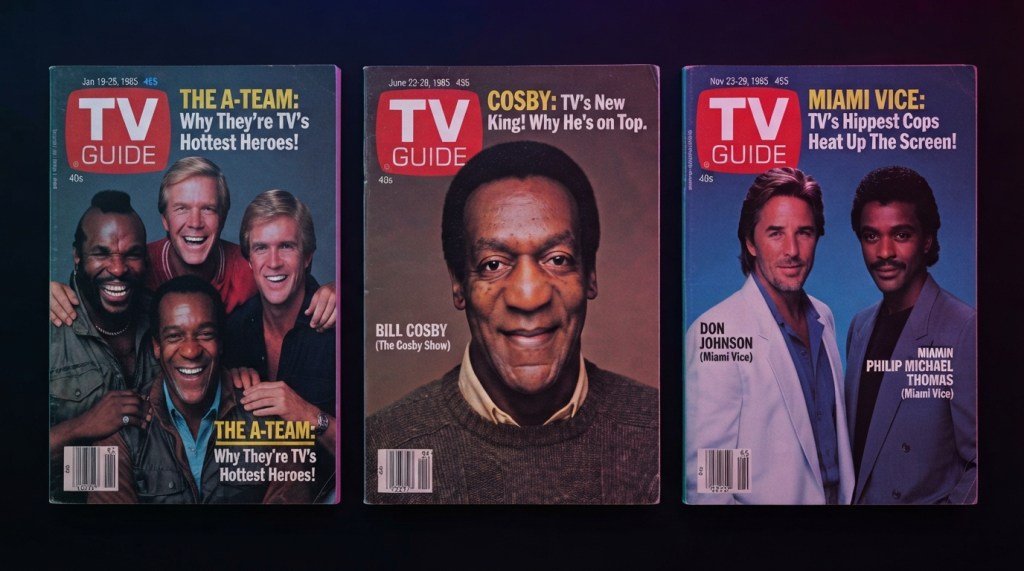
In 1985, finding out what was on television was not something you did by pressing a button on the remote.
You looked it up.
A television guide could sit on the coffee table, beside the television or on the kitchen counter. It contained schedules for the coming days, often organized by channel and time. People could look ahead to see when their favourite shows were coming on and plan around them.
This was especially important because television schedules mattered. If a show came on Tuesday night at 8:00, you had to remember that. If you missed it, you couldn’t simply open a streaming service and watch it later.
People would circle programs, underline them, write notes beside them or simply remember the schedule. The guide could also become part of family discussions. Someone might say, “What’s on tonight?” and another person would reach for the TV guide.
The television itself was still the centre of the room, but the printed schedule was almost an extension of it. The guide told you what was happening and when.
Today, television has become almost the opposite. Instead of adapting our schedules to television, we often expect television to adapt to us. We can search, record, stream, pause and watch programs whenever we want.
The little printed TV guide sitting beside the television is therefore more than an old piece of paper. It represents a time when television was something you planned your evening around.
Encyclopedias
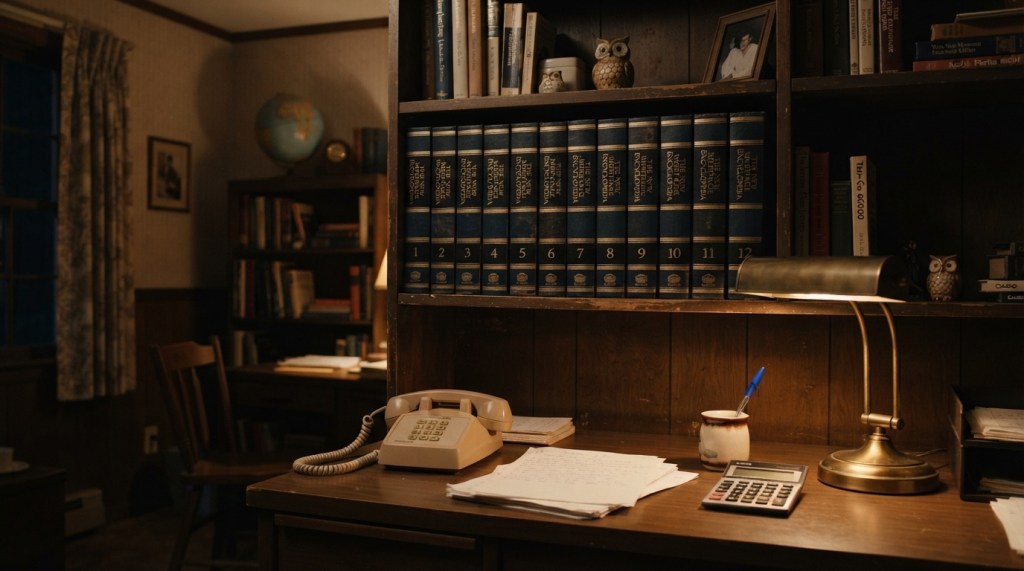
There was a time when a large set of books could be considered an essential source of knowledge for a household.
Encyclopedias were often sold as complete sets, sometimes consisting of many matching volumes arranged alphabetically. They looked impressive on a bookshelf because they took up a considerable amount of space. The books might have matching covers and gold lettering, making them look almost like a permanent fixture in the room.
Children were particularly familiar with them. If you needed information for a school assignment, an encyclopedia was one of the places you could begin. You could look up a country, historical figure, animal, scientific subject or almost anything else and read a few pages about it.
Finding information required a little effort. You needed to know which letter to look under and then locate the appropriate entry. Sometimes you would begin with one subject and end up reading about something completely different because you happened to notice another interesting entry along the way.
The books were also expensive enough that owning a complete set could feel like a serious investment in education. They weren’t simply decorative books.
Today, enormous amounts of information can be accessed almost instantly. A child researching a school project is far more likely to search online than pull an encyclopedia from a shelf.
The encyclopedia set is therefore one of those objects that tells us how dramatically the meaning of “having information” has changed. In 1985, information occupied physical space. It sat on a shelf and had weight.
Answering Machines
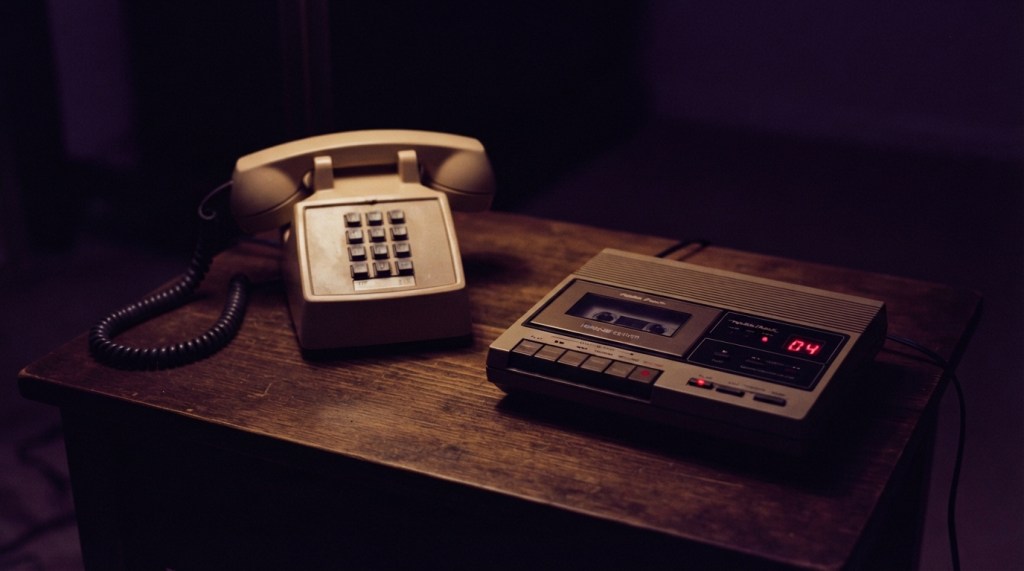
Before voicemail became a standard feature of telephone service and mobile phones, many households relied on answering machines.
An answering machine usually sat beside the telephone. When someone called and nobody answered, the machine would pick up and play a recorded greeting. The caller could then leave a message.
The machine itself became part of the household routine. People checked it when they came home. They might press a button and listen to the recorded messages while standing beside the telephone.
There was also the question of the greeting. Some people simply recorded their name and asked callers to leave a message. Others tried to be funny or creative. Children sometimes recorded greetings just because they enjoyed hearing their voices through the machine.
And then there was the anticipation of hearing whether someone had called.
Today, a missed call or voicemail appears almost instantly on a smartphone. Messages can be read, saved, deleted or listened to from almost anywhere.
The answering machine was much more physical. It was a small box sitting in your house, quietly waiting for the telephone to ring. You couldn’t check it from the grocery store or while walking down the street. You had to physically return home and press the button.
That little machine was an early step toward the always-connected world we now take for granted.
Ashtrays Everywhere
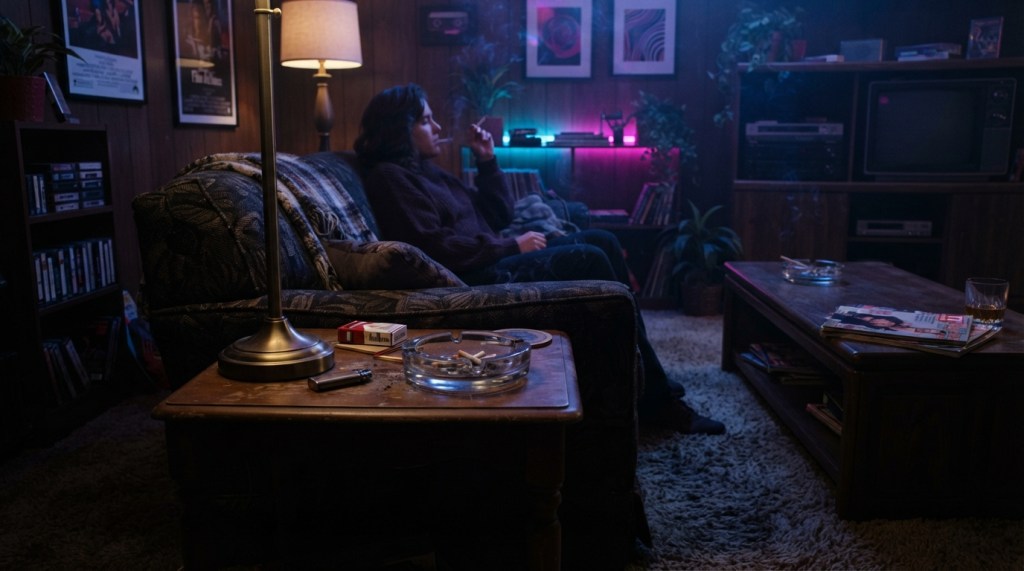
Perhaps one of the strangest things about an ordinary 1980s home to someone today would be the number of ashtrays.
They could be on coffee tables, end tables, desks, patios, kitchen counters and sometimes even built directly into furniture. Restaurants had them. Hotels had them. Offices had them. Cars had them.
You didn’t necessarily have to be a smoker to own an ashtray. Having one around was considered normal because somebody might smoke at some point.
Ashtrays also came in all kinds of designs. Some were plain glass or ceramic. Others were souvenirs from restaurants, hotels or vacations. Businesses sometimes gave them away as promotional items with their names and telephone numbers printed on them.
A person could walk into a living room in 1985 and see an ashtray sitting on the coffee table without finding it remarkable at all.
That world has changed dramatically. Smoking restrictions, changing attitudes and health awareness removed smoking from many indoor public spaces and eventually from many homes. The ashtray went with it.
Today, an ashtray sitting in the middle of a living room would immediately attract attention. In 1985, nobody would have thought twice about it.
Few everyday objects demonstrate social change as clearly.
Paper Calendars and Appointment Books
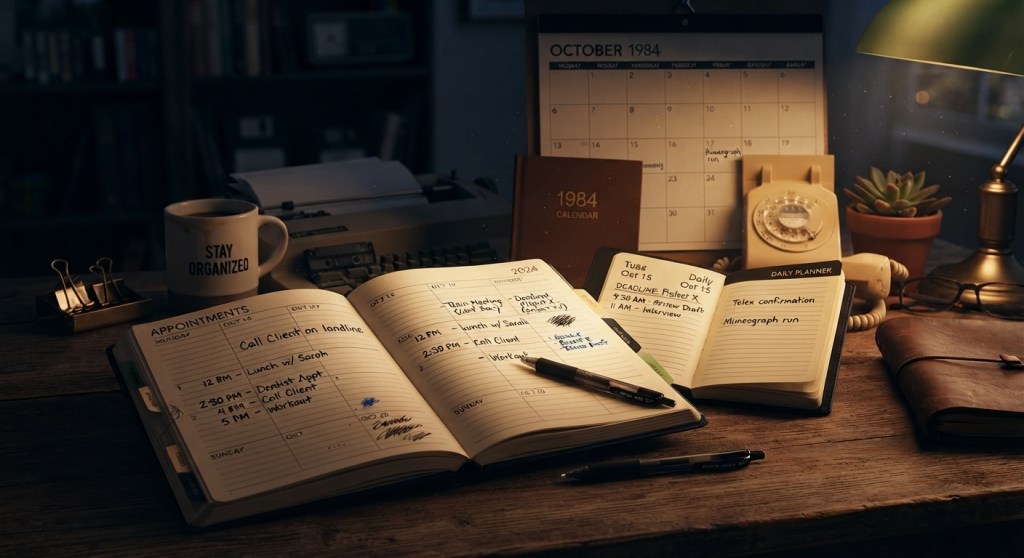
Calendars were everywhere.
There could be a large calendar hanging on the kitchen wall, another one in an office, a smaller desk calendar at work and perhaps a little pocket calendar carried around in a purse or wallet.
The calendar wasn’t just something you looked at to find the date. It was a place to write things down.
Appointments, birthdays, meetings, school events, vacations, bill due dates and family activities could all be written directly into the squares. A kitchen calendar could become a kind of information centre for the entire household.
You could look at it and immediately see that someone had a dentist appointment Thursday, a birthday party Saturday and a meeting Monday.
The writing on the calendar was part of its usefulness. People’s handwriting filled the squares as the year went on. Some entries were written in pen, others in pencil. Important events might be circled or underlined.
Today, calendars still exist, of course, but much of this information has moved onto phones and computers. Reminders can appear automatically. Appointments can be shared between people. Birthdays can be remembered without anyone writing them down.
The old kitchen calendar was simpler, but it was also visible. Everybody in the house could see it.
Address Books and Rolodexes
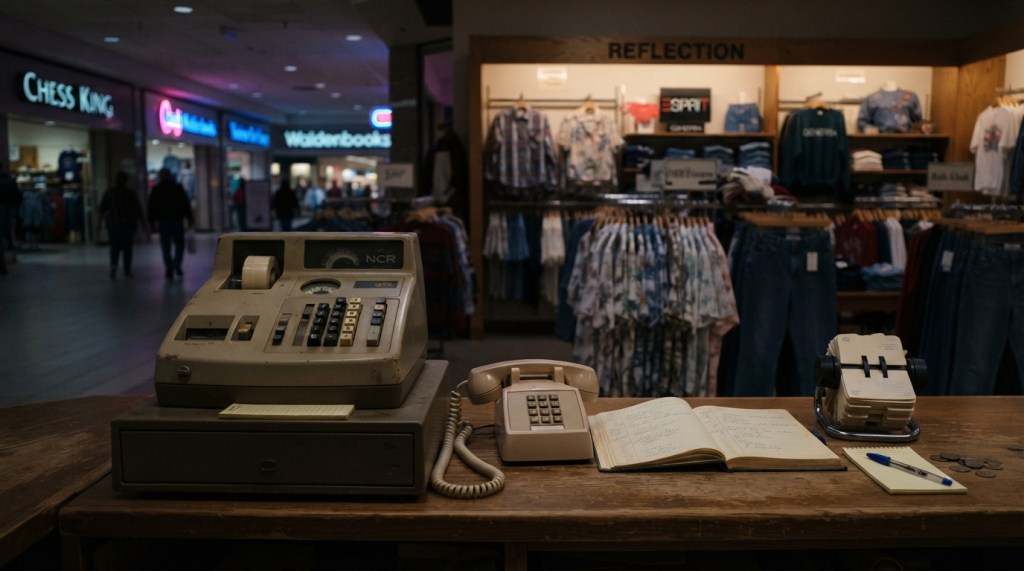
Before contact lists could store hundreds or thousands of names, people had address books.
They were often small enough to carry but substantial enough to hold years of information. You could write someone’s name, home address, telephone number and sometimes their work information.
An address book could become surprisingly valuable over time. It contained information that was difficult to replace if the book was lost.
Businesses had their own version: the Rolodex.
A Rolodex sat on a desk and held individual cards containing contact information. You could flip through the cards until you found the person you needed.
The physical movement of the cards became part of the experience of office life. You could add a new contact, remove an old one or scribble a correction on an existing card.
Today, contact information is stored digitally. A person’s phone number can change and be updated without crossing anything out. Addresses can be searched instantly, and contacts can be synchronized across multiple devices.
An old address book tells a different story. It shows information that was deliberately written down and physically maintained.
You can sometimes find an old address book today and see names of people who haven’t been thought about in years. That makes these little books surprisingly personal pieces of history.
Pay Phones and Phone Booths
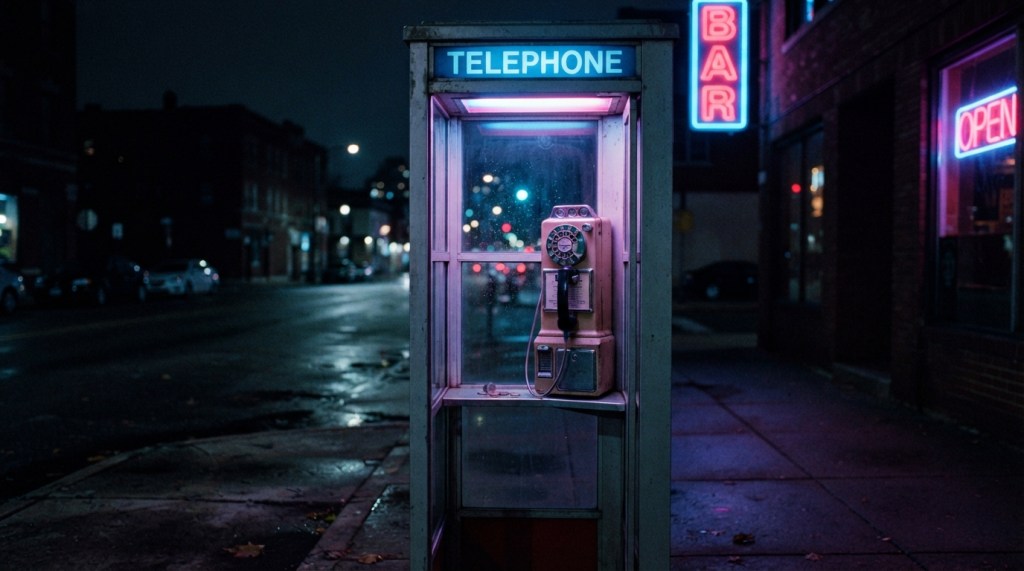
There was a time when making a telephone call while away from home meant finding a telephone.
That could mean a pay phone outside a store, inside a shopping mall, at a gas station, in a restaurant, at an airport or on a street corner. Some were enclosed in traditional phone booths, while others were simply mounted to a wall or standing in a public area.
You needed coins.
That alone made a difference. People often carried change specifically because they might need to make a telephone call.
Phone booths were also places where private conversations could take place in public. You could close the door, pick up the receiver and make a call without everybody nearby hearing the conversation.
The phone booth eventually became one of the clearest symbols of a disappearing technology. Once mobile phones became common, the need for public telephones declined dramatically.
Today, a young person can carry a phone capable of communicating with almost anyone on Earth without thinking about where the nearest telephone is.
In 1985, however, if you were out and needed to call home, finding a phone could be part of the problem.
Film and Printed Photographs
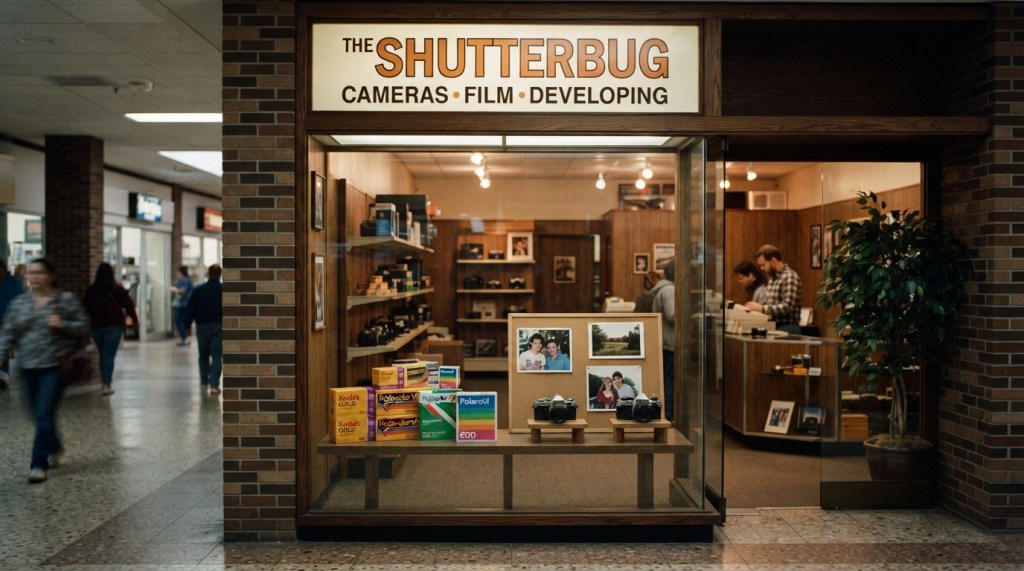
Taking a photograph in 1985 was not an instant experience.
You loaded film into a camera, took your photographs and then waited until the roll was finished. After that, the film had to be developed.
You didn’t immediately know whether the photograph turned out.
Someone could have blinked. The picture could have been too dark. The flash might not have worked. The subject could have moved. You wouldn’t know until the film came back.
Eventually, you received physical photographs. They could be placed into albums, frames or boxes.
Photo albums became family records. People could sit together and turn the pages, looking at birthdays, vacations, Christmas mornings, weddings, school events and ordinary family moments.
There was also something special about having a limited number of photographs. You didn’t take fifty pictures of the same plate of food or twenty nearly identical photographs of a sunset. Film cost money, and there were only so many exposures available.
Today, people can take hundreds of photographs without giving much thought to the cost. Images live on phones, computers and cloud services rather than in boxes and albums.
Printed photographs haven’t disappeared completely, but the ordinary process of taking pictures has changed so much that the old film experience now feels almost ceremonial.
Paper Catalogues and Mail-Order Forms
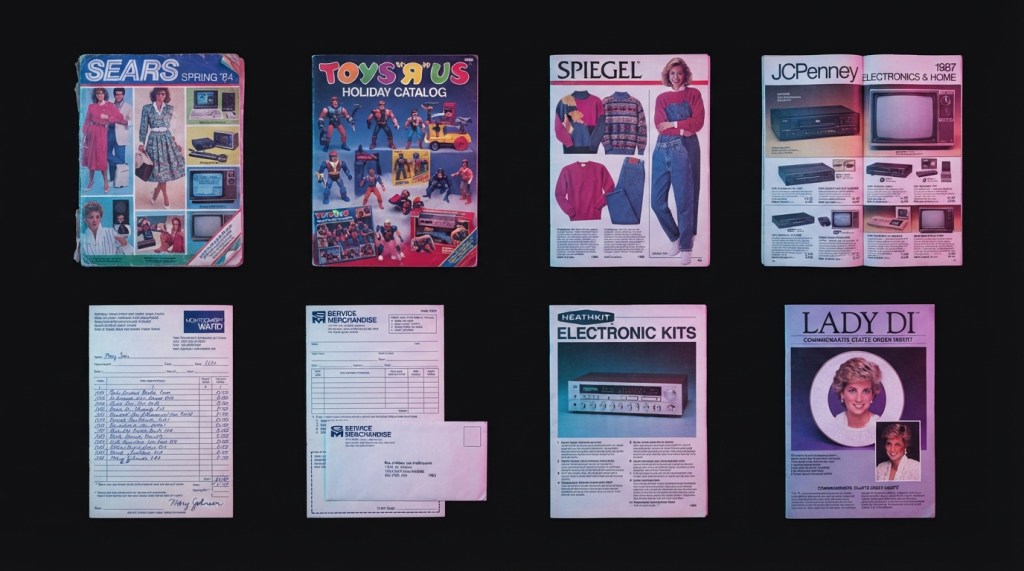
A catalogue arriving in the mail could be a major event.
Large catalogues from department stores and mail-order companies could contain hundreds of pages showing clothing, toys, electronics, furniture, appliances and household goods.
People could sit down and look through them at their own pace. Children especially might study the toy sections, looking at the products they wanted for Christmas or birthdays.
The catalogue wasn’t interactive. You couldn’t click a photograph to see more information. You couldn’t instantly compare prices with another store. You couldn’t watch a video demonstrating the product.
Instead, you looked at the printed photograph, read the description and perhaps circled the item.
Some catalogues included order forms. You filled them out, selected the items you wanted and mailed the form or placed an order by telephone.
The whole process could take days or weeks.
Today, online shopping has replaced almost every part of that experience. A person can search for a product, compare prices, read reviews, watch demonstrations and order it within minutes.
The physical catalogue has therefore become an unusual object. Yet for many people who grew up in the 1980s, flipping through those pages was part of the excitement of shopping.
Carbon Paper and Carbon-Copy Forms
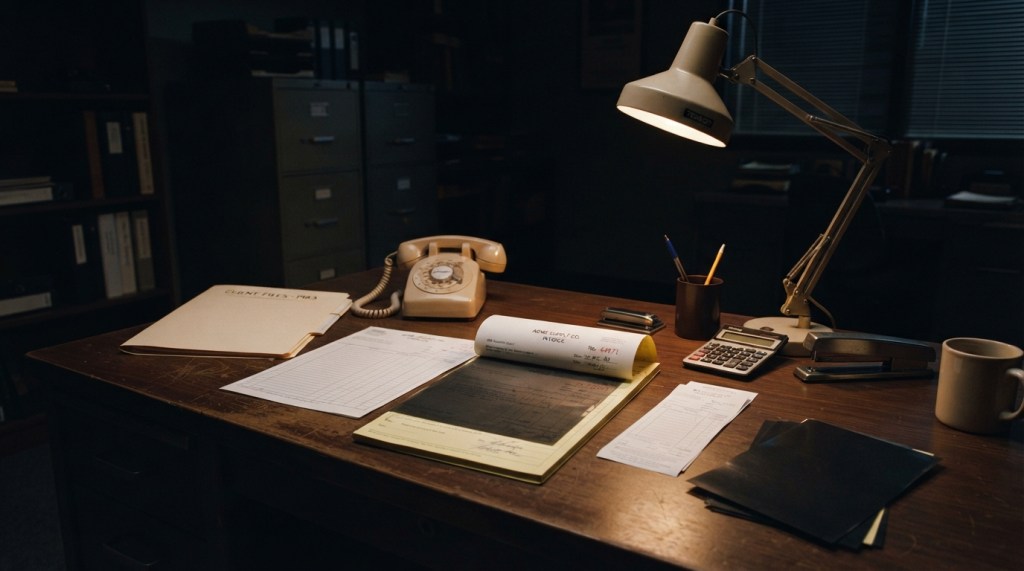
Carbon paper was one of those things that people used without giving it much thought.
You placed a sheet of carbon paper between two pieces of paper. When you wrote on the top sheet, the pressure transferred the writing onto the sheet underneath.
It was a simple way of making copies before photocopiers and digital documents became everyday tools.
Carbon copies were common in offices, businesses, stores and various kinds of paperwork. Forms could have multiple copies, allowing different people or departments to keep their own records.
The technology was not particularly glamorous, but it was useful.
You could often recognize a carbon-copy form by the thin sheets of paper and the slightly messy feeling of working with them. Mistakes couldn’t simply be corrected by pressing a button. A typo could mean crossing something out, rewriting the form or starting again.
Today, people can create a document and make as many digital copies as they want. Printers and scanners handle much of the physical paperwork that once required carbon paper.
The fact that carbon paper was once an ordinary office supply and is now something many younger people have never used is a perfect example of how quickly everyday technology can disappear.
Printed Manuals, Warranty Cards and Registration Forms
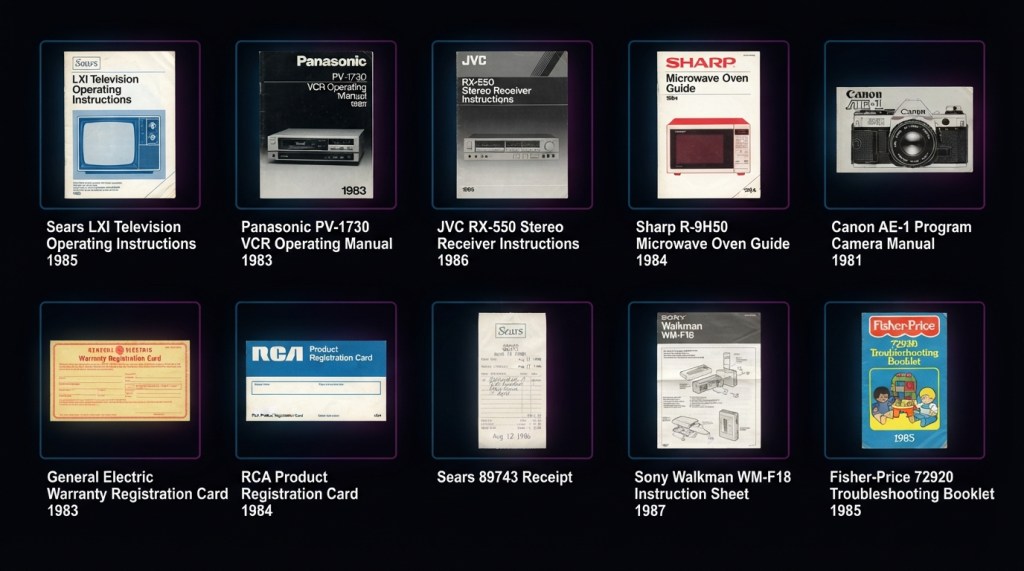
Almost everything came with paperwork.
Buy a television, and there was a manual. Buy a VCR, and there was a manual. Buy a stereo, toaster, microwave, camera, vacuum cleaner or electronic toy, and you could expect some kind of printed instructions.
The manuals varied from tiny instruction sheets to thick booklets containing diagrams, troubleshooting information and technical specifications.
There were also warranty cards and product registration forms.
After buying something, you might be expected to fill out a card with your name, address, product information and purchase details. The card would then be mailed to the manufacturer.
This was such a normal part of buying products that people could have drawers filled with manuals, warranties and receipts.
Today, manuals are increasingly digital. A manufacturer can put instructions online, and customers can download a PDF or watch a video explaining how something works.
Even the idea of registering a product has changed. Much of it can happen automatically online.
The old paperwork had one advantage: if you kept it, you actually had something physical to refer back to. Many households had a drawer or cupboard where all those manuals ended up.
The Little Things Around the Telephone
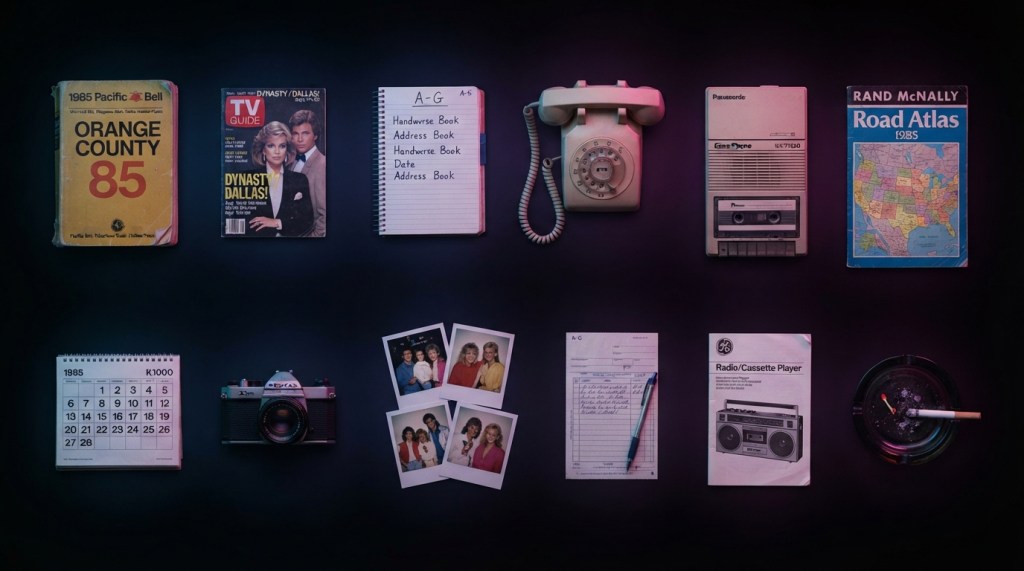
Perhaps the best way to finish this list is with the objects that gathered around the telephone.
The telephone itself was only part of the setup.
There might be a notepad for taking messages, a pen or pencil, a phone book, a Yellow Pages directory, an address book and perhaps an answering machine. There could be a little telephone table or shelf designed specifically for the phone.
The phone area of the house was almost a small information centre.
If someone called while another family member was out, you wrote down the message. If you needed a number, you looked it up. If you needed to make a note while talking, you reached for the pad.
Sometimes there were even little message pads printed specifically for telephone calls, with spaces for the caller’s name, number, time and message.
Today, the telephone has absorbed almost all of these functions. Your phone stores numbers, takes messages, records reminders, searches for businesses, keeps notes and tells you who is calling.
That is why the old telephone table is such an interesting piece of 1980s history. It wasn’t just furniture. It was the physical centre of household communication.
The Objects We Never Thought Would Disappear
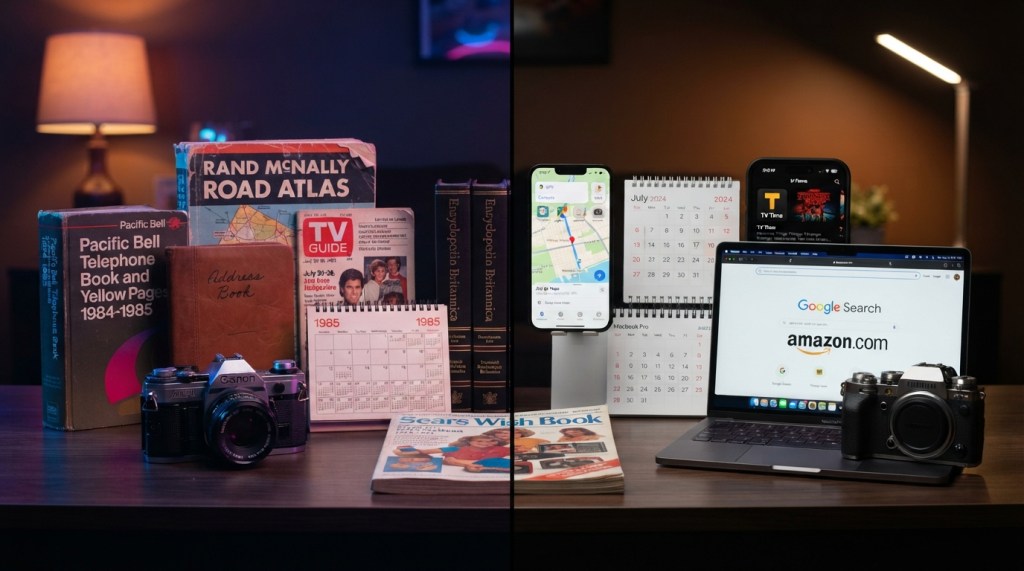
The most interesting thing about these objects is that almost none of them seemed important when they were being used.
Nobody in 1985 woke up and thought, “Someday the phone book will become a nostalgic object.” Nobody looked at a TV Guide and imagined that people would eventually stream entire seasons of television without checking a printed schedule. Nobody putting a road map into the glove compartment realized that one day a small computer in their pocket would know their exact location and guide them almost anywhere.
That is the strange thing about everyday life. We usually notice important inventions when they arrive, but we don’t always notice ordinary objects when they disappear.
The disappearance usually happens gradually. First, a new technology appears. Then a few people start using it. Eventually it becomes cheaper or easier. More people adopt it. The old object becomes less useful. Stores stop selling it as often. People stop keeping it in their homes. A younger generation grows up without ever needing it.
Eventually, something that was once everywhere becomes something you might find in a box in someone’s basement.
That’s what makes this kind of nostalgia different from simply remembering popular toys or movies. These objects were part of the background of everyday life. They were not usually the things people were excited to show their friends. They were simply there.
A phone book was there when you needed a number. A map was there when you needed directions. An encyclopedia was there when you needed information. A TV Guide was there when you wanted to know what was on. An address book was there when you needed someone’s contact information. A calendar was there when you needed to remember an appointment.
And then, almost without anyone noticing, all of those jobs moved somewhere else.
They moved into computers, websites and eventually smartphones.
That is why walking into a home from 1985 would probably feel stranger than looking at a collection of famous 1980s memorabilia. You would recognize the television, the furniture and many of the appliances, but then you would start noticing all the little things that don’t belong in a modern home anymore.
There would be paper everywhere.
Books containing information. Calendars containing appointments. Maps containing roads. Directories containing telephone numbers. Forms containing records. Photographs containing memories. Catalogues containing products.
The physical world carried an enormous amount of information.
Today, much of that information has become invisible. It sits inside devices and online services that can be accessed almost instantly. That is incredibly convenient, but it also means that many of the physical objects that once surrounded us have vanished.
And perhaps that is why seeing an old phone book, a yellowed road map, an answering machine or a TV Guide can produce such a strange feeling.
It isn’t necessarily the object itself that we miss.
It is the world that existed around it.
A world where you had to look something up instead of searching for it. Where you had to write something down because your phone couldn’t remember it for you. Where getting somewhere could involve unfolding a map across the dashboard. Where photographs had to be developed before you knew whether they were any good. Where watching television meant knowing what time a program started. Where calling someone meant finding a telephone.
Those things weren’t considered inconvenient at the time. They were simply normal.
And that may be the most fascinating thing about looking back at 1985. The 1980s weren’t just a decade of big hair, colourful clothes, video games and pop music. They were an everyday world filled with thousands of ordinary objects that quietly shaped how people lived.
Most of them disappeared without a farewell.
That’s what makes them worth remembering now.
 Totally Retro: 80s Edition
Leave a comment